
Agriculture constantly has to adapt to real-world changes in climate and weather. This year has been particularly wet so far, making it almost impossible for traditional farming machinery to move on the field. Wet and muddy conditions prevent the fertilizing of the fields and therefore present a real threat to the potential yield. Traditionally, fertilizing would have to be pushed far back into the season to wait for better conditions, so farmers are looking for alternatives.
In those conditions, a drone can come in handy as it is not affected by the conditions of the soil. Here the challenge lies in the high application rates, more than 100 kg per hectare. Join us on our journey as we help the Havellandhof, a farm close to the German village Ribbeck. Together with the Institute of Agricultural and Urban Ecological Projects (IASP), we are doing nitrogen fertilization on one of Havellandhof’s fields. We will show you through this challenge, showcasing the preparation and the execution of the mission, and later talk about a few key learnings that we had during our mission.
Preparation
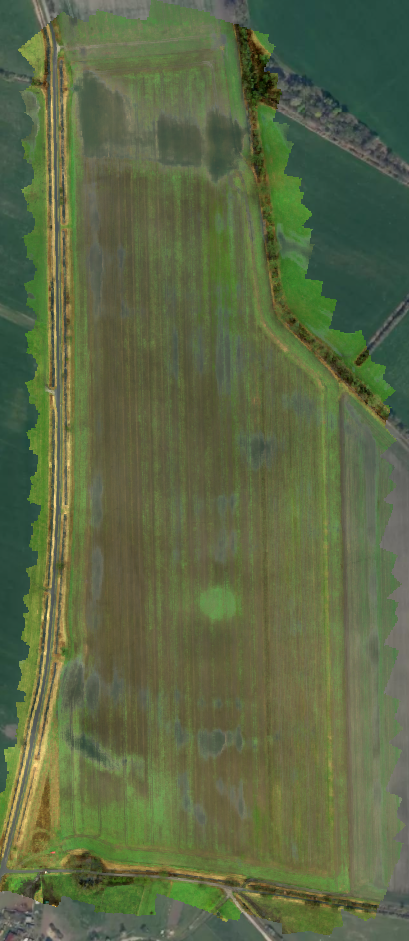
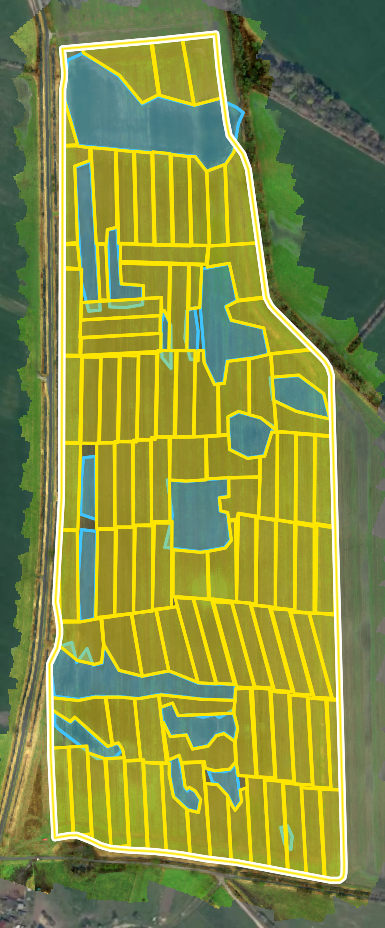
As for any big challenge, preparation is the key to efficient drone operation, regardless of mission type. The first step in the planning was to make an orthomosaic of the field with a mapping drone. The field has a size of around 27 ha. The mapping of the field and generation of the map took around one hour. With the field mapped, we were able to identify puddles, cultivated areas, and areas where plants have not been able to grow. This information is necessary to determine the flight path of the drone during the fertilization process. For example, the application of fertilizer in the puddles was not wanted, so we planned ahead accordingly by modifying the flight path of the drone around the puddles. This flexibility is one of the key strengths of the drone.
The next step was to divide the field into manageable polygons. The key goal for the division was to minimize the distance flown without application or with an empty tank. Therefore, a couple of parameters had to be determined:
- Application rate: This is the most important parameter for any spreading mission as it is the limiter for most other parameters such as polygon size, flight speed during application, or necessary volume flow. It also serves as a baseline to determine all other parameters. For this mission, our goal application rate was 60 kg of nitrogen per hectare. The fertilizer itself has 46% nitrogen, bringing the total application rate to 125 kg of fertilizer per hectare.
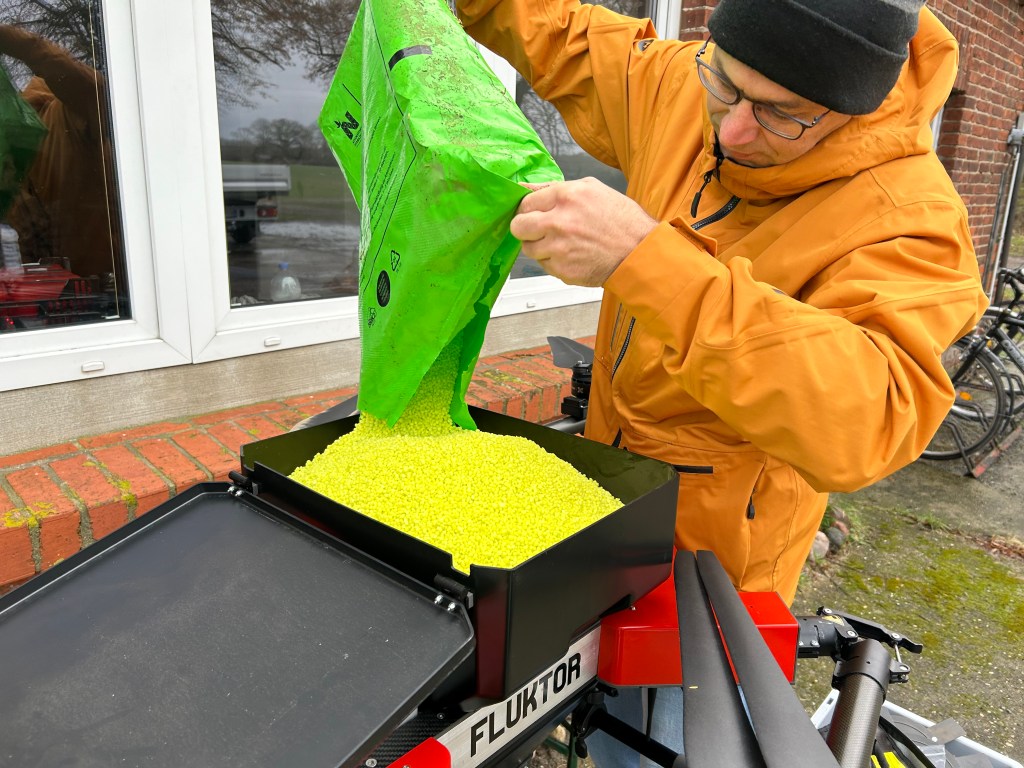
- Tank volume: This parameter influences the size of each polygon. The tank of the CS50 drone holds up to 30 l volume. For this fertilizer, it meant that we could comfortably carry 25 kg of fertilizer per flight. Together with the application rate we can now determine the size of each individual polygon to be 0.2 hectares.
- Flow rate: With this parameter, we are able to calculate the horizontal flight velocity for each polygon. To find it we filled up the tank of the drone with fertilizer and ran the dosing shaft for 90 sec. We then measured the total weight of fertilizer that was pushed out by the dosing shaft at that time. This gave us a flow of 85 grams of fertilizer per second. Together with the size of the polygons we can now determine the flight velocity to be around 0.7 meters per second.
- Polygon shape: Lastly we needed to define the overall shape of each polygon. Again, the goal was to minimize the number of flights without application or with an empty tank. This means keeping the starting point and the endpoint of each mission as close to the takeoff point as possible and only using a turnaround when necessary. Under these circumstances, the best shape was a polygon with a rectangular shape and dimensions of 20 meters by 100 meters.
With all those predetermined parameters it was time to cut the field into the segments. This worked mostly but due to the puddles, and the overall shape of the field, it was not always possible. In these cases, the polygon shape was changed to fit the circumstances while keeping the size at around 0.2 hectares. This way we could ensure that the mass of fertilizer would be sufficient for each polygon.
Execution
With the preparations done, it was time to move on to the execution. The day of the execution promised nice weather with low wind conditions which made it ideal to to fly the drone and spread the fertilizer. We loaded up the car and made our way to the field. Since we had made a good plan it was simply a matter of filling the tank, loading the path onto the drone, and executing the mission. The groundwork was split into two positions. One person was refilling the tank and checking the batteries, while the other person was responsible for the piloting. This way our ground times have been around 2 minutes per mission.
Here’s what a typical flight looked like:
- First, the tank was filled and the remaining battery capacity was checked. If the battery capacity was not sufficient enough for the next flight, the battery was changed to a full one.
- During filling the pilot loaded the next mission into the Fluktor app and checked the settings.
- Once all settings were confirmed and the drone was ready to go, the pilot took off manually and flew to the starting point of the mission.
- Then the mission was started within the Fluktor App. The drone executed the mission fully autonomously.
- Once the mission was finished the pilot took over the sticks again to fly the drone back to the car for refilling and a potential battery change.
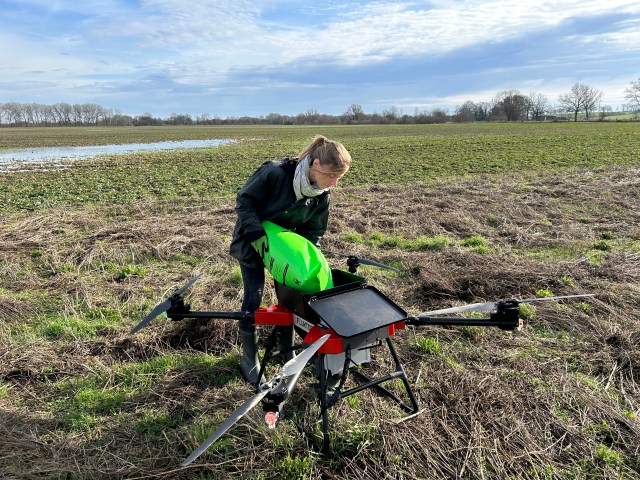
To charge the batteries in the field, we utilized a petrol generator. The generator had enough power to simultaneously charge two batteries. This meant that we could ensure continuous operation with two chargers and six batteries. During our first flight, we were able to cover an area of 3.2 hectares in three hours. During those three hours, we had a total of two hours of flight time and one hour of ground time.
Key Learnings
During these first tests, we learned a lot to improve the system and also the workflow. The first thing we learned is that preparation is key. This is especially true for the planning of the individual missions as it would take some time in the field to adjust them. This can lead to small inefficiencies that could, over time, lead to less area coverage at the same time. Secondly, we learned that it is much faster to fly the drone manually to the starting point of the mission. This is due to a higher velocity that can be reached in manual flight. This also applies to the return back to the pilot.
We have also learned that the dosing shaft is not big enough for these high application volumes. It would be better to increase the volume flow. If the volume flow were higher, we could fly faster during the missions. This change can already be made due to the versatility of the Lehner FlyDos Spreading unit. We can change the shaft to one with bigger cell wheels, increasing our volume flow. This would lead to an overall increased efficiency. First tests with bigger cell wheels showed an increased volume flow from 85g/s up to 200g/s, almost tripling the flow.
We have now implemented our key learnings for our next tests to see the improvements we can yield. Stay tuned for updates on this matter in the next few weeks.

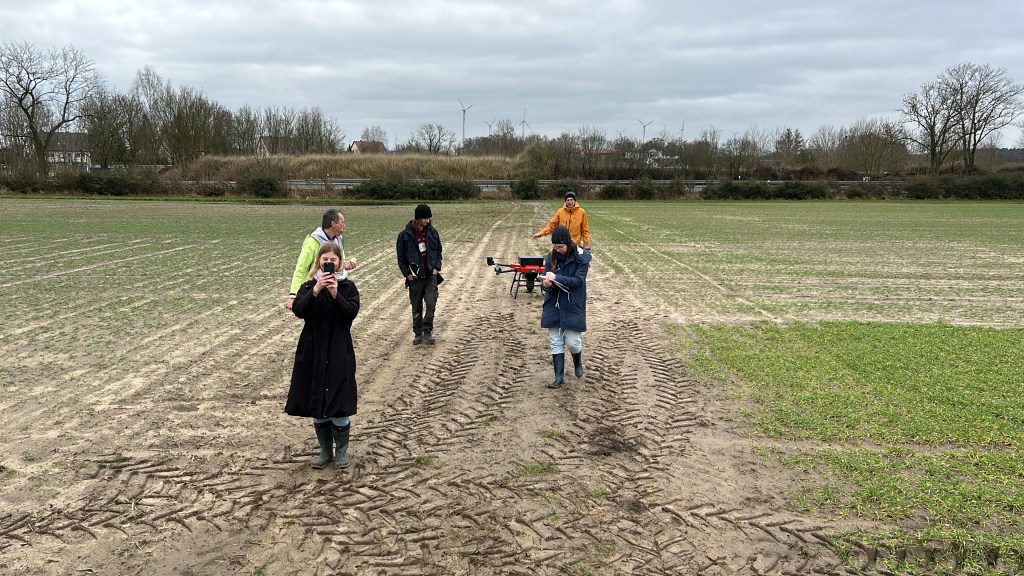

The results of the application were published in the online edition of agrarheute on 28 February 2024.
 IG4D
IG4D 